Customer expectations have evolved dramatically in the digital age. Businesses are expected to deliver instant responses, personalized experiences, and seamless communication across multiple channels.
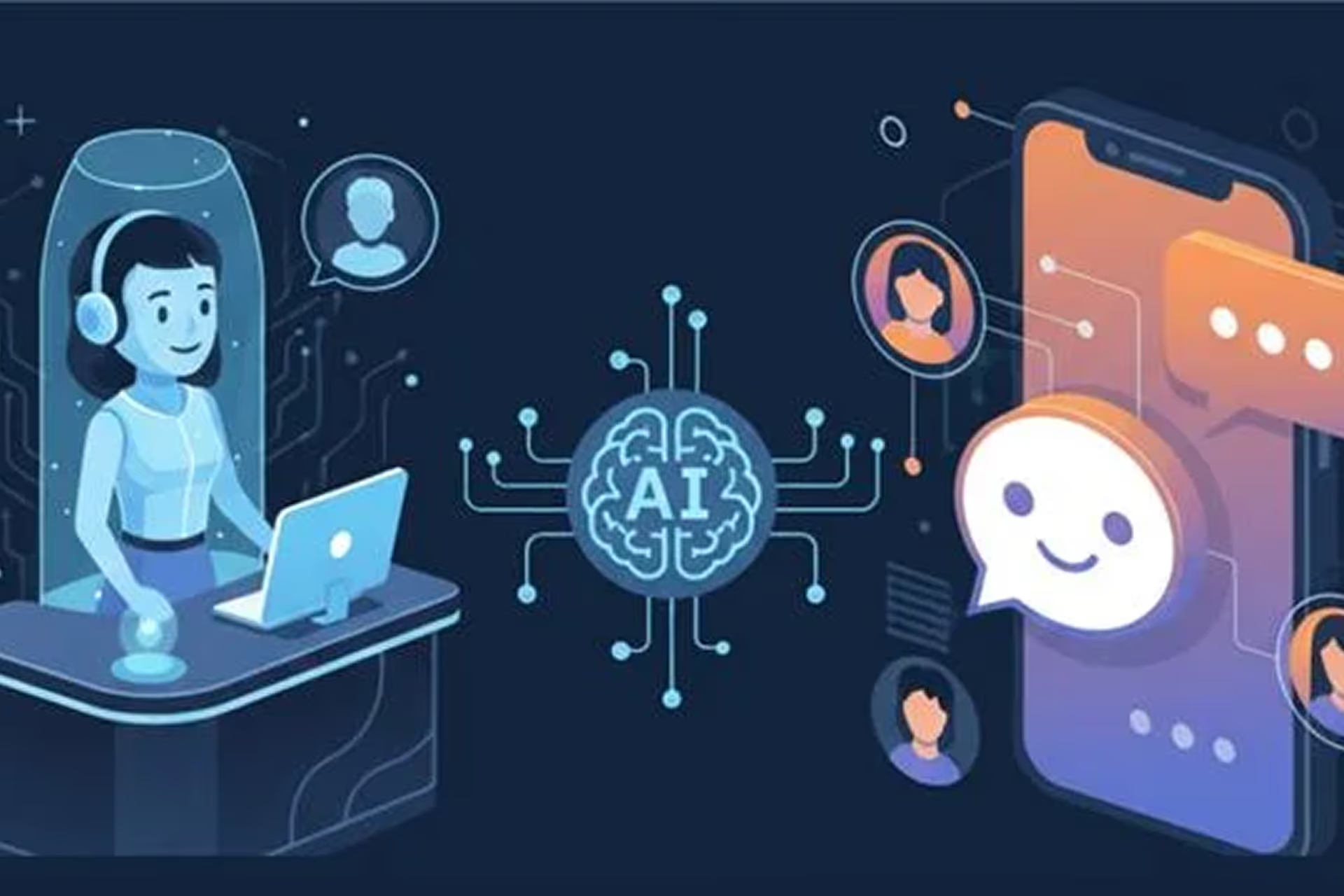
Artificial intelligence is transforming how companies manage customer interactions. From AI-powered receptionists to advanced conversational chatbots, organizations are using AI to improve service efficiency and deliver better customer experiences.
This article explores how AI technologies are redefining customer engagement across industries.
Today’s customers expect immediate responses and personalized service. Traditional customer support systems often struggle to keep up with high volumes of customer inquiries.
AI-driven customer experience solutions enable businesses to:
Organizations adopting AI-powered customer service solutions can enhance both efficiency and customer engagement.
AI receptionists are voice-based virtual assistants designed to handle incoming calls and customer inquiries automatically.
These systems can:
AI receptionists operate 24/7, ensuring that customers always receive assistance even outside regular business hours.
Chatbots have become essential tools for digital customer support across websites, mobile apps, and messaging platforms.
Modern AI chatbots use natural language processing (NLP) to understand user queries and provide relevant responses.
Common chatbot use cases include:
AI chatbots allow businesses to manage large volumes of customer conversations efficiently.
Generative AI technologies are taking chatbot capabilities to the next level.
Instead of relying only on predefined responses, generative AI models can create contextual and human-like responses during conversations.
Benefits of generative AI chatbots include:
This technology enables businesses to provide highly engaging digital support experiences.
Modern customers interact with brands through multiple channels including websites, mobile apps, email, social media, and voice assistants.
AI-powered systems help unify these channels into a single seamless customer experience.
An omnichannel AI system can:
This integrated approach improves both customer satisfaction and operational efficiency.
Several technologies power modern AI-driven customer engagement platforms.
NLP enables systems to understand human language and interpret customer queries accurately.
Machine learning algorithms help AI systems continuously improve their responses based on previous interactions.
Speech recognition technology enables voice-based assistants such as AI receptionists.
Conversational AI frameworks enable organizations to deploy intelligent chatbots across multiple platforms.
Together, these technologies enable powerful automated customer support systems.
Organizations that adopt AI-driven customer engagement solutions gain several competitive advantages.
AI systems respond instantly to customer inquiries, reducing wait times.
Automation reduces the workload for human support teams.
Businesses can handle large volumes of customer interactions without increasing support staff.
AI systems provide round-the-clock support for global customers.
The most effective customer experience strategies combine multiple AI tools.
For example:
This hybrid approach ensures efficient support while maintaining a high level of service quality.
As organizations implement AI-driven customer service systems, ensuring security and responsible AI usage becomes critical.
Key considerations include:
Responsible AI practices help organizations build trust with their customers.
Artificial intelligence will continue to transform how businesses interact with customers.
Future developments may include:
These innovations will enable businesses to deliver highly personalized and proactive customer experiences.
Companies that invest in AI-driven customer experience technologies can deliver faster service, improve engagement, and gain a competitive advantage.
By integrating AI receptionists, intelligent chatbots, and omnichannel support systems, businesses can build scalable and efficient customer service platforms for the future.
A strategic guide to migrating from Firebase to Supabase, focusing on cost optimization, open-source infrastructure, and data sovereignty.
Learn how combining Ruby on Rails for AI-driven frontends and Golang for high-throughput microservices creates a powerful hybrid architecture.
Explore how AI-driven personalization in Moodle enables adaptive learning paths and intelligent training experiences for modern enterprises.