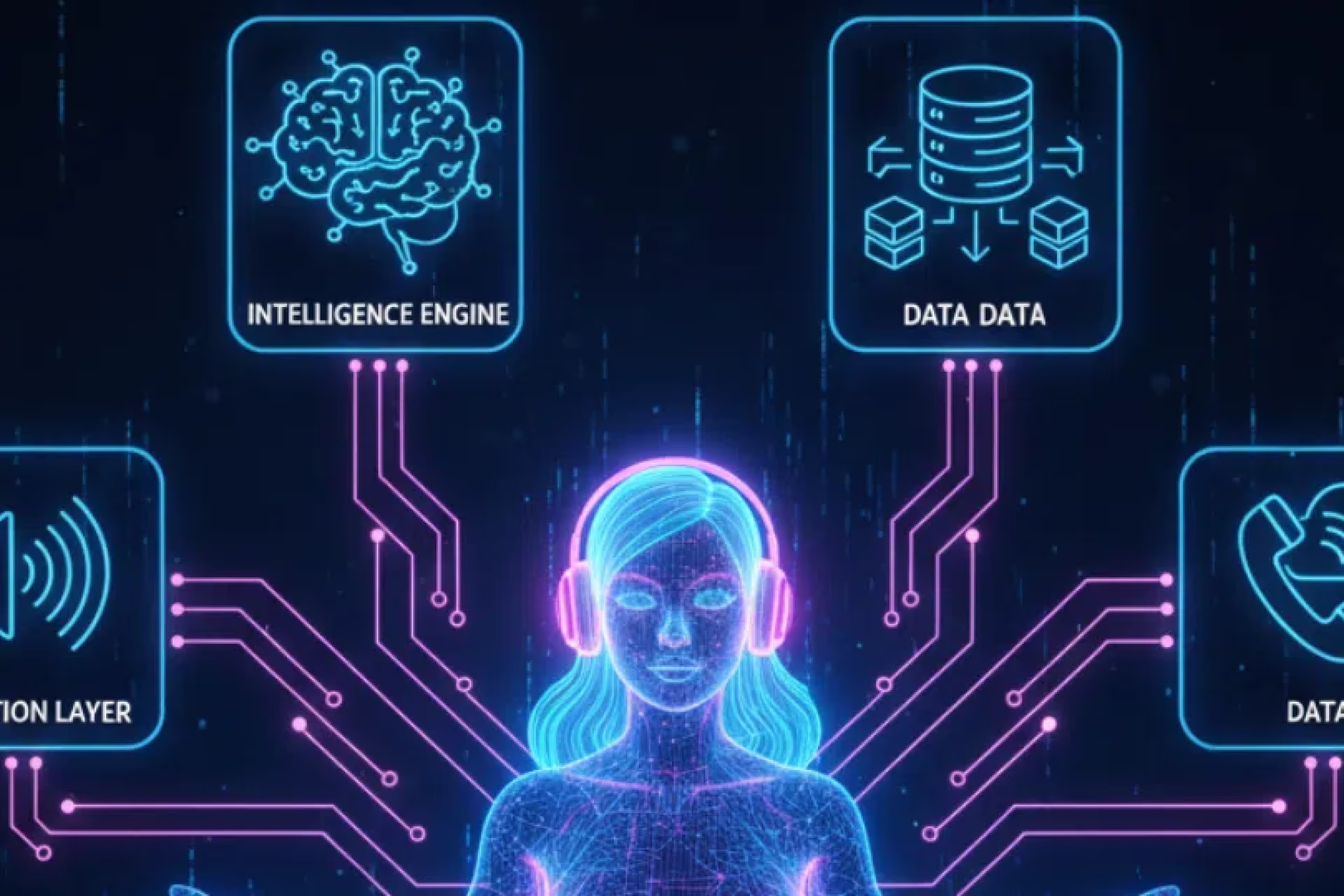
Businesses today are increasingly adopting artificial intelligence to automate customer interactions and streamline operations. One of the most impactful implementations is the AI receptionist, a virtual assistant that can handle calls, messages, appointment scheduling, and customer inquiries.
An AI receptionist improves response times, reduces operational costs, and ensures consistent customer service around the clock.
In this guide, we explore how businesses can design and deploy an AI receptionist solution effectively.
An AI receptionist is a virtual assistant powered by artificial intelligence technologies such as natural language processing (NLP), machine learning, and speech recognition.
It acts as a digital front desk that interacts with customers through voice or chat interfaces.
Typical functions include:
By automating these interactions, businesses can focus human staff on more complex tasks.
Before building an AI receptionist, organizations must clearly define their use cases.
Examples include:
Clearly identifying these use cases helps determine the capabilities your AI receptionist needs.
A successful AI receptionist relies on well-designed conversation flows.
Conversation design should focus on creating intuitive and natural interactions between customers and the AI system.
Key considerations include:
Well-designed conversational flows ensure a better customer experience.
Building an AI receptionist requires selecting the right technologies and frameworks.
Speech-to-text technology converts spoken language into text so that AI systems can understand voice commands.
NLU helps AI systems understand the intent and meaning behind customer messages or speech.
LLMs generate intelligent responses that feel natural and conversational.
TTS converts AI responses back into natural sounding speech.
Integration with internal systems ensures the AI receptionist can perform real tasks like scheduling meetings or retrieving data.
For an AI receptionist to be effective, it must integrate with internal systems such as:
These integrations enable the AI to provide accurate, personalized responses.
RAG architecture enables AI systems to retrieve relevant knowledge from internal databases before generating responses.
This improves the accuracy of AI interactions by ensuring answers are based on verified business information.
Benefits of RAG include:
Even the most advanced AI systems require human assistance for complex scenarios.
An AI receptionist should include escalation mechanisms that allow conversations to be transferred to human agents when necessary.
Examples include:
This hybrid approach ensures both efficiency and reliability.
Security is a critical component of any AI deployment.
Organizations must ensure that AI receptionist systems comply with privacy and security regulations.
Key measures include:
AI systems require scalable infrastructure to support large volumes of conversations.
Cloud platforms provide the flexibility and scalability needed for AI deployments.
Benefits include:
After deployment, continuous training and optimization are necessary to improve performance.
Organizations should regularly analyze:
This process helps refine the AI system and improve customer experiences over time.
AI receptionists provide several advantages for modern businesses.
Customers receive immediate assistance regardless of time zones or business hours.
Automating routine tasks reduces the workload on human teams.
AI systems provide faster responses and personalized interactions.
Organizations can significantly reduce staffing and operational costs.
Traditional IVR systems rely on rigid menu structures that can frustrate users.
AI receptionists provide a far more intuitive experience by allowing customers to communicate naturally through voice or text.
Instead of navigating complex menus, customers simply state their requests.
AI receptionists can be used across multiple industries.
Examples include:
AI receptionists represent the next evolution of customer communication. By combining conversational AI, automation, and enterprise integrations, businesses can deliver faster and more efficient customer service.
Organizations that adopt AI-powered receptionists today position themselves for improved scalability, operational efficiency, and enhanced customer satisfaction.
A strategic guide to migrating from Firebase to Supabase, focusing on cost optimization, open-source infrastructure, and data sovereignty.
Learn how combining Ruby on Rails for AI-driven frontends and Golang for high-throughput microservices creates a powerful hybrid architecture.
Explore how AI-driven personalization in Moodle enables adaptive learning paths and intelligent training experiences for modern enterprises.