Modern software development requires rapid innovation without compromising reliability. Organizations are expected to deliver new features quickly while ensuring applications remain stable, secure, and high performing.
DevOps has transformed the way teams build and deploy software, enabling continuous delivery and faster development cycles. At the same time, QA automation has become essential for maintaining product quality during rapid releases.
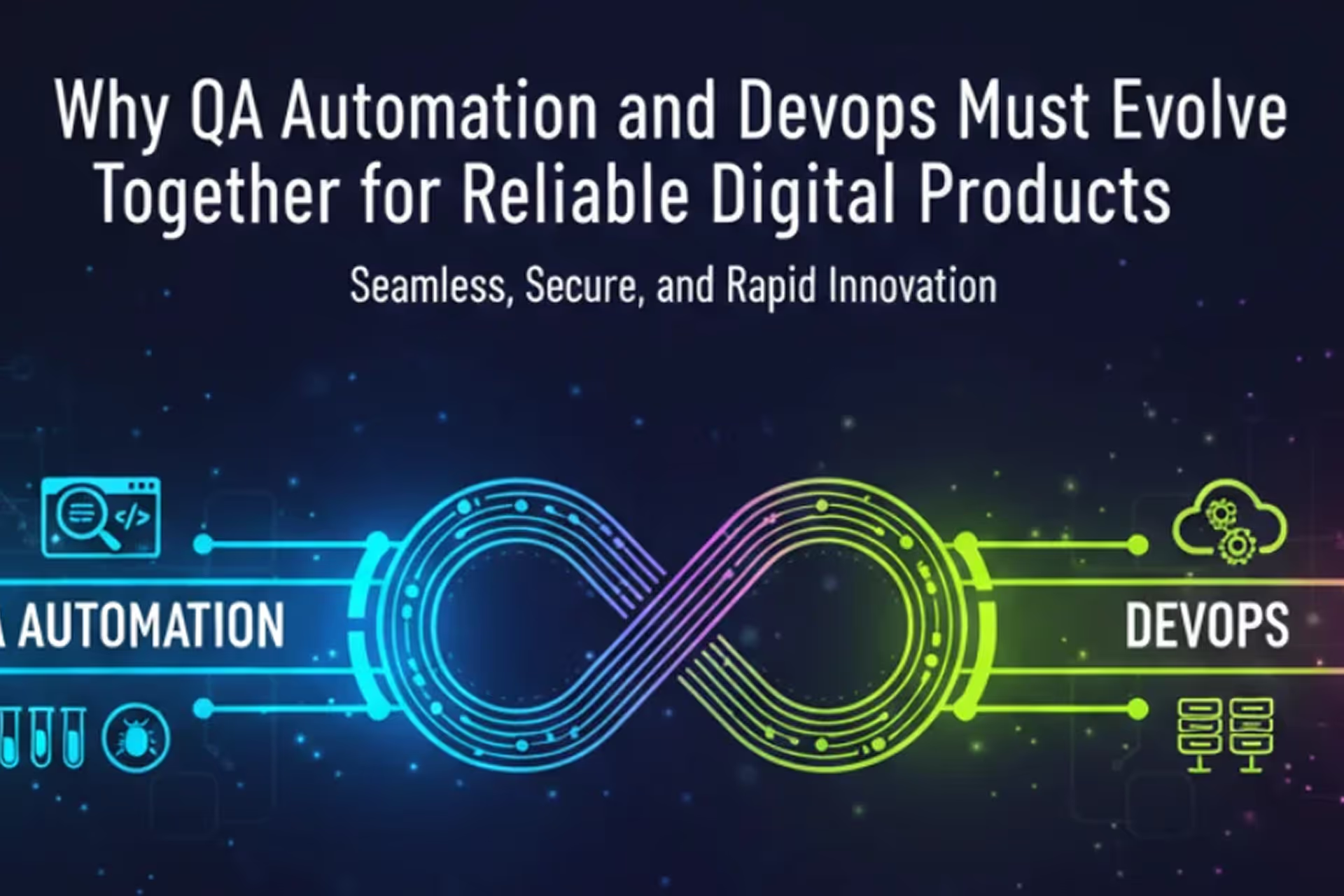
However, DevOps and QA automation cannot operate in isolation. To build reliable digital products, these two disciplines must evolve together as part of an integrated development strategy.
Traditional software development cycles often involved long release timelines and manual testing processes. This approach made it difficult for organizations to adapt quickly to market demands.
Modern development environments now rely on:
These practices allow teams to deliver software updates faster while maintaining high standards of quality.
To understand why these practices must work together, it is important to examine their individual roles in software development.
DevOps is a development approach that emphasizes collaboration between development and operations teams. It focuses on automating infrastructure, streamlining deployments, and enabling continuous delivery of software.
DevOps practices typically include:
QA automation involves using automated testing tools and frameworks to verify software functionality and performance.
Automated tests can include:
Automation helps teams test applications faster and more consistently than manual testing methods.
Many organizations still treat testing as a separate stage that occurs after development is completed.
This traditional approach can create several problems:
When QA processes are disconnected from development workflows, teams struggle to maintain product quality during rapid release cycles.
Continuous testing integrates automated testing directly into the DevOps pipeline.
Instead of running tests only at the end of development cycles, automated tests are executed throughout the development process.
Continuous testing enables:
This integration ensures that quality assurance becomes a continuous process rather than a final checkpoint.
Integrating QA automation with DevOps delivers significant advantages for modern development teams.
Automated testing ensures that rapid development cycles do not compromise product stability.
Testing environments can mirror production infrastructure, enabling teams to detect environment-specific issues earlier.
Automated test suites can be executed during every code deployment, ensuring that new changes do not break existing functionality.
Developers receive immediate feedback from automated tests, enabling faster bug fixes and improved code quality.
Organizations that integrate DevOps with QA automation gain several operational benefits.
Continuous testing ensures that issues are detected early in the development process.
Automated testing allows teams to deploy updates more frequently without compromising quality.
Automated quality checks reduce the likelihood of production failures.
Teams spend less time manually testing and more time building innovative features.
To successfully integrate QA automation with DevOps, organizations should adopt several best practices.
Automated testing should run throughout the development lifecycle.
Separate environments ensure accurate testing conditions without affecting production systems.
Testing infrastructure configurations helps prevent deployment errors.
Development, operations, and QA teams must work together as part of a unified workflow.
Modern digital products increasingly rely on cloud-native architectures and AI-driven applications.
These systems require advanced testing strategies, including:
Integrating DevOps and QA automation ensures these complex systems remain reliable and scalable.
Quality engineering is evolving beyond traditional QA practices.
Future software development strategies may include:
These technologies will further strengthen the integration between development, operations, and quality assurance.
Reliable digital products cannot be built with development speed alone. Quality must be embedded directly into the software development lifecycle.
By integrating QA automation into DevOps pipelines, organizations can deliver faster releases while maintaining high standards of reliability and performance.
Companies that embrace this integrated approach will be better positioned to build scalable, resilient, and high-quality digital products in an increasingly competitive digital landscape.
A strategic guide to migrating from Firebase to Supabase, focusing on cost optimization, open-source infrastructure, and data sovereignty.
Learn how combining Ruby on Rails for AI-driven frontends and Golang for high-throughput microservices creates a powerful hybrid architecture.
Explore how AI-driven personalization in Moodle enables adaptive learning paths and intelligent training experiences for modern enterprises.